















News
-
 10 2026.08
Is a Thin Layer of Activated Carbon in Your Air Filter Actually Doing Anything?
Flip over almost any air purifier box and you'll see "activated carbon" printed somewhere on it. What the box usually doesn't tell you is how much carbon is inside — and in many cases, it's a thin coated sheet weighing a few grams. So is a thin layer activated carbon filter real filtration, or mostly marketing? The honest answer: it depends on three numbers. Why "Activated Carbon" on the Label Doesn't Mean Much Why do air purifiers use so little activated carbon? Mostly cost and space. A deep bed of granular carbon is s...
view details
-
 07 2026.08
How to Select Activated Carbon for Mercury Removal from Flue Gas
Activated carbon injection (ACI) is the most widely used technology for mercury control in coal-fired power plants, waste incinerators and industrial boilers. But mercury removal performance cannot be predicted by iodine number or carbon price alone. Mercury enters the flue gas as elemental vapor (Hg⁰), oxidized mercury (Hg²⁺) or particulate-bound mercury (Hgₚ). Each form behaves differently, and the split depends on fuel composition, chlorine/bromine content, combustion temperature and existing air-pollution-control (APC) ...
view details
-
 05 2026.08
How to Select Activated Carbon for H₂S Removal in Biogas
Why H₂S Removal Matters in Biogas Hydrogen sulfide (H₂S) forms during anaerobic digestion of sulfur-rich organic matter. Its concentration varies with feedstock, digestion conditions, and process design. Common H₂S sources in biogas: Municipal wastewater sludge Food-processing waste Animal manure Agricultural residues Landfill waste Industrial organic wastewater If H₂S is not adequately removed, it causes pipe corrosion, engine damage, membrane contamination, reduced catalyst life, odor complaints,...
view details
-
 29 2026.07
Activated Carbon for Sugar Syrup Decolorization: A Trader’s Sourcing Guide
Why Sugar and Syrup Decolorization Requires a Specialized Carbon Raw and partially refined sugar solutions may contain caramelized compounds, melanoidins, polyphenols, colloidal material, oxidation products and other organic color bodies. These impurities can affect the appearance of the final sugar, syrup or sweetener product and may complicate downstream filtration and crystallization. General-purpose water-treatment carbon is not automatically suitable for this application. Many drinking-water carbons are selected primar...
view details
-
 29 2026.07
How to Select Activated Carbon for Food and Beverage Processing
Activated carbon selection should be based on the product, target impurities, process conditions and filtration method. Why Activated Carbon Is Used in Food and Beverage Manufacturing Activated carbon contains an extensively developed internal pore structure. Organic molecules, pigments, odor compounds and other impurities can be adsorbed onto the internal surface of these pores as a liquid passes through or contacts the carbon. In food and beverage production, activated carbon is commonly used for: Reducing unwanted color...
view details
-
 28 2026.07
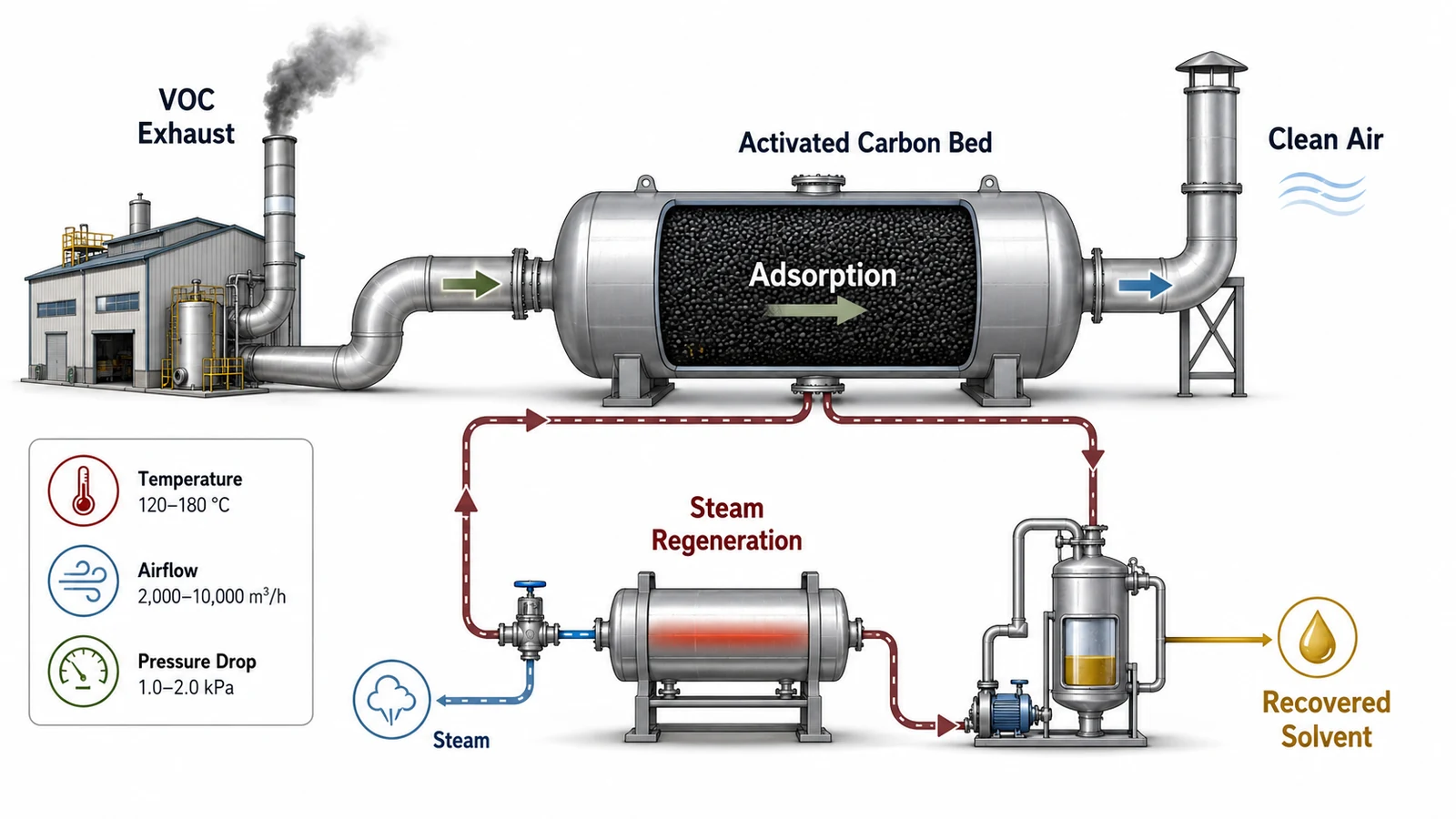
CTC 60 vs 80 vs 100 Activated Carbon for VOCs
A higher CTC value usually indicates a higher gas-phase activation level. It does not mean that 100% CTC carbon will remove 100% of VOCs, last twice as long as a 50% grade or provide the lowest operating cost in every adsorber. A plant handling moderate and intermittent solvent emissions may obtain better economics from a 60% CTC grade. A regenerable solvent recovery unit may benefit from 80% CTC. A compact system with continuous high organic loading may justify a 100% CTC product, provided the VOC composition, airflow, pre...
view details